Live · Online · Weekly

Online Darbuka Lessons

Live group classes in darbuka — the goblet drum at the rhythmic heart of Middle Eastern music — with students from twenty-five countries. Yshai Afterman has been teaching percussion online since 2010, sixteen years of online teaching.
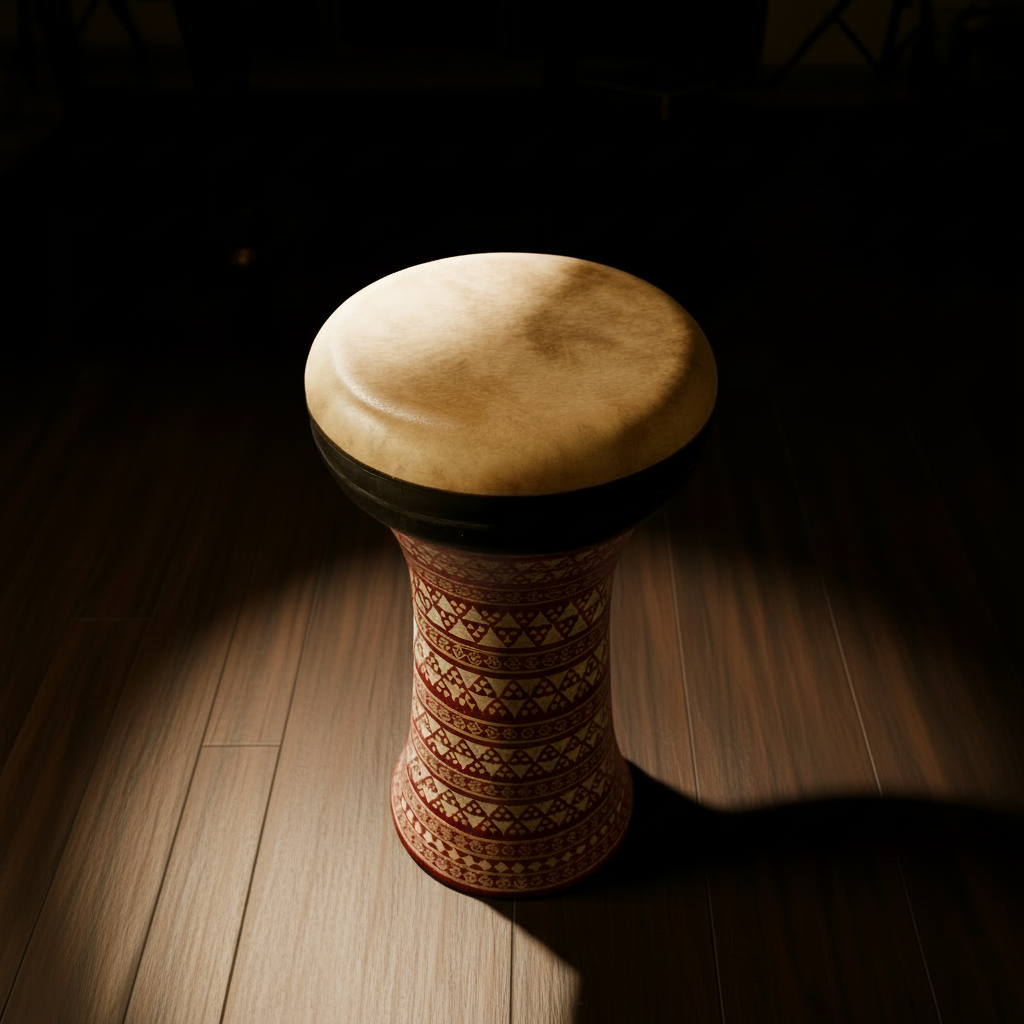
Darbuka — goblet drum

“Online darbuka lessons” here doesn't mean occasional tips or isolated classes. It refers to a structured, long-term process: a comprehensive method for building the language of rhythm itself — layer by layer, over months — guided through weekly live sessions with a small, dedicated group of students from around the world.

The Instrument

About the darbuka

The darbuka — also known as the doumbek, tablah, or derbake — is a goblet-shaped, single-headed hand drum that sits at the rhythmic centre of Middle Eastern and Mediterranean music. Its narrow waist and wide head give it a voice of unusual range: a deep, round bass tone (the doum) struck in the centre of the head, and bright, cutting accents (the tek and ka) played at the rim with the fingertips.

What makes the darbuka demanding is also what makes it rewarding: clean, distinct strokes; even, controlled rolls; true independence between the hands; and the ability to ornament a groove without ever losing its pulse. These are exactly the foundations the curriculum builds, in order, from your very first lesson.

The same core skills carry everything — basic strokes, split-hand technique, triplet rolls, and the techniques built on these. With them you go deep into the traditional rhythms of the Arabic, Turkish, Greek, Balkan, and North African worlds — and especially their odd meters — and, in time, into improvising and composing inside them.

The Method

Three pillars. One crown.

The Conservatory's darbuka program is a complete arc — from foundations to musicianship — unfolding layer by layer, every concept built on the one before, through a body of original compositions written specifically for this method. It rests on three pillars — Time, Language, and Expression — that together form a complete musical understanding.

I Time
Knowing the rhythmic cycle intimately. The more deeply you inhabit a groove, the more freely you play inside it.
II Language
Technique, grouping, phrasing, composition — not patterns to copy, but tools to create with.
III Expression
Tension and release, dynamics, phrasing — the branches that make playing alive rather than correct.

The Curriculum

What you study

1
Hand technique
Basic strokes, split-hand technique, triplet rolls, and the techniques built on these.
2
Rhythmic cycles & time
The rhythmic cycles at the heart of the tradition — with a deep focus on odd meters: 5/8, 7/8, 9/8 and beyond, drawn from Arabic, Turkish, Greek, Balkan, and North African rhythms.
3
Traditional repertoire
Traditional rhythms from across the Arabic, Turkish, Greek, Balkan, and North African worlds — and more — with original compositions written over them, the way real musicians learn music.
4
Phrasing & language
Not patterns to copy, but a vocabulary to think in. The drum becomes an extension of how you hear and speak musically.
5
Improvisation & ornamentation
The independence to make music genuinely your own — to invent, decorate, and respond inside any musical setting.
6
Sound, time, & expression
The deeper relationship between technique and feeling — the difference between playing correctly and playing alive.
90 min
Live on Zoom, Weekly
A full structured immersion every week — technique, repertoire, and musicianship, with dedicated time for questions.
300+
Original Compositions
Solos, exercises, and compositions written specifically for this method — building on each other across levels.
1,700+
Lessons Taught
Seven years of teaching this method to successive cohorts of students — the depth that only repeated teaching produces.
1 : 1
Private Feedback
Every two weeks, submit a video for personal feedback from Yshai — staying close to your evolution, even in a group.
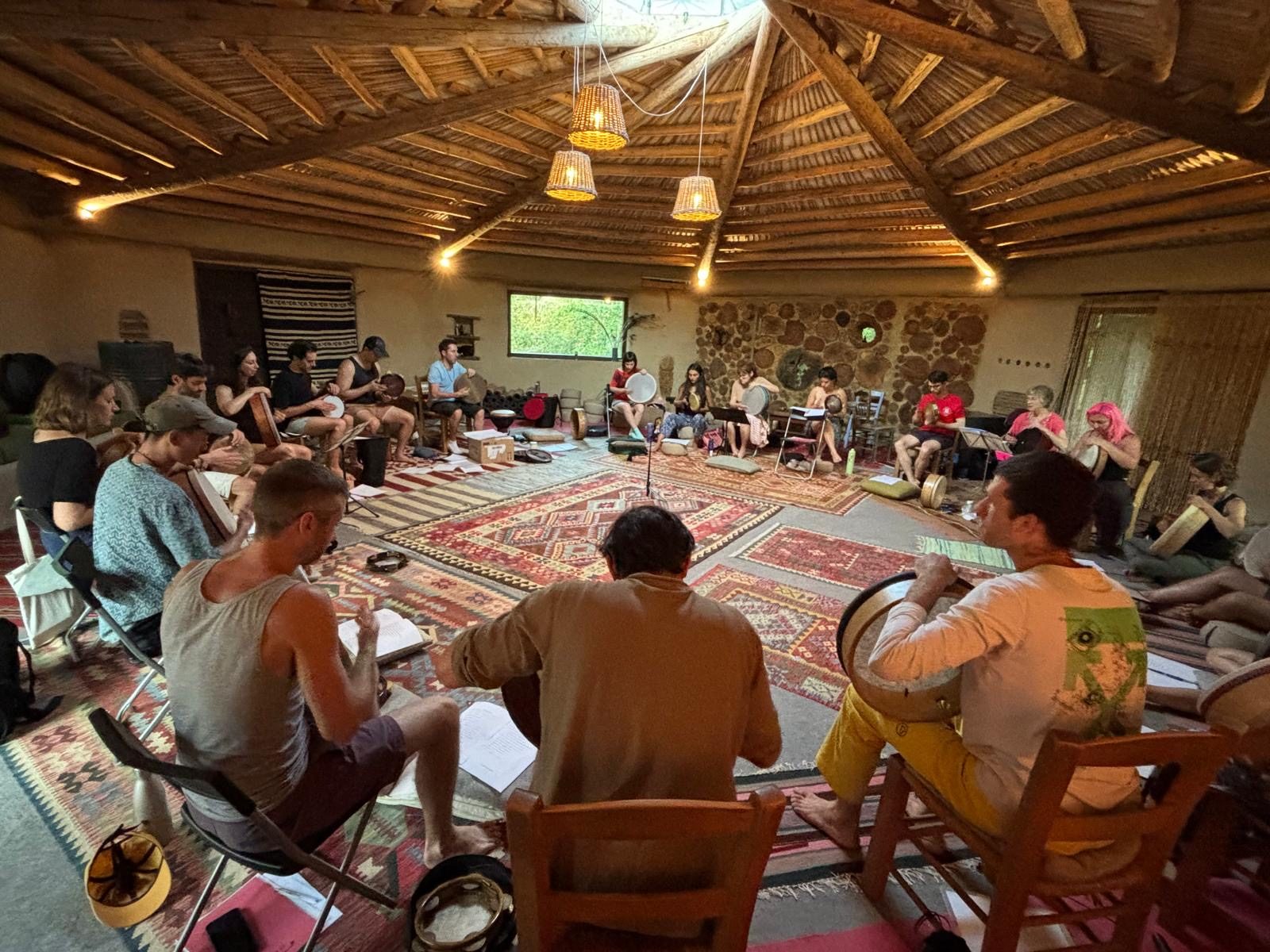
Conservatory students learning together in a circle at the annual in-person seminar

More than lessons

You join a community, not a course

Studying the darbuka here means more than a weekly class. You become part of a worldwide community of dedicated students — from twenty-five countries and counting — learning the same goblet-drum language together, with a calendar of shared events running alongside the curriculum.

That calendar includes an ongoing Masterclass Series with guest masters from the global percussion world, and an annual in-person Seminar where students gather to play, eat, and learn side by side.

Weekly
Live darbuka classes 90 minutes on Zoom, taught by Yshai
Monthly
Masterclass Series Guest masters from the global percussion world
Annual
In-person Seminar A week of music, meals, and shared practice

Inside the portal

Every darbuka lesson, at your fingertips

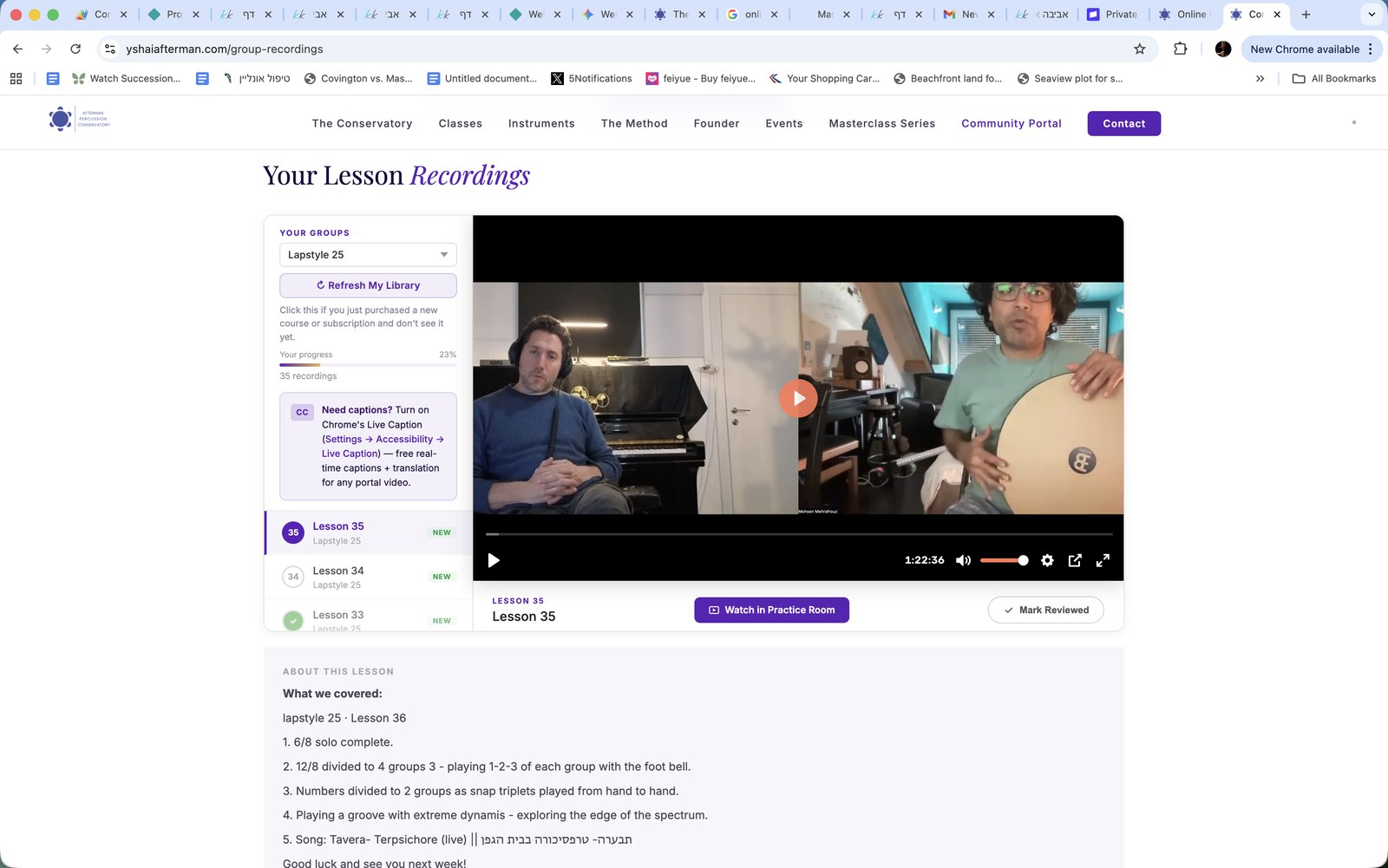
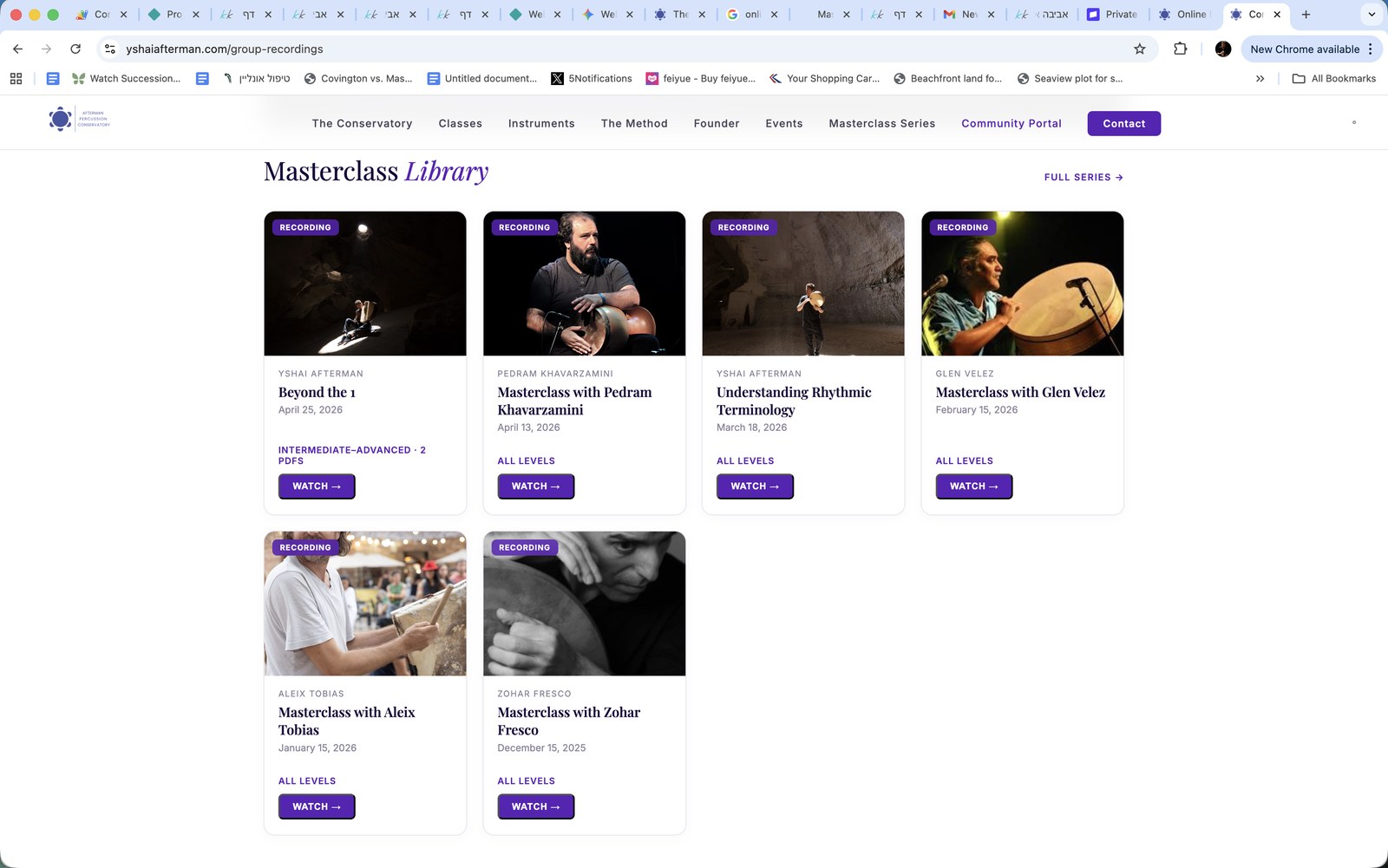
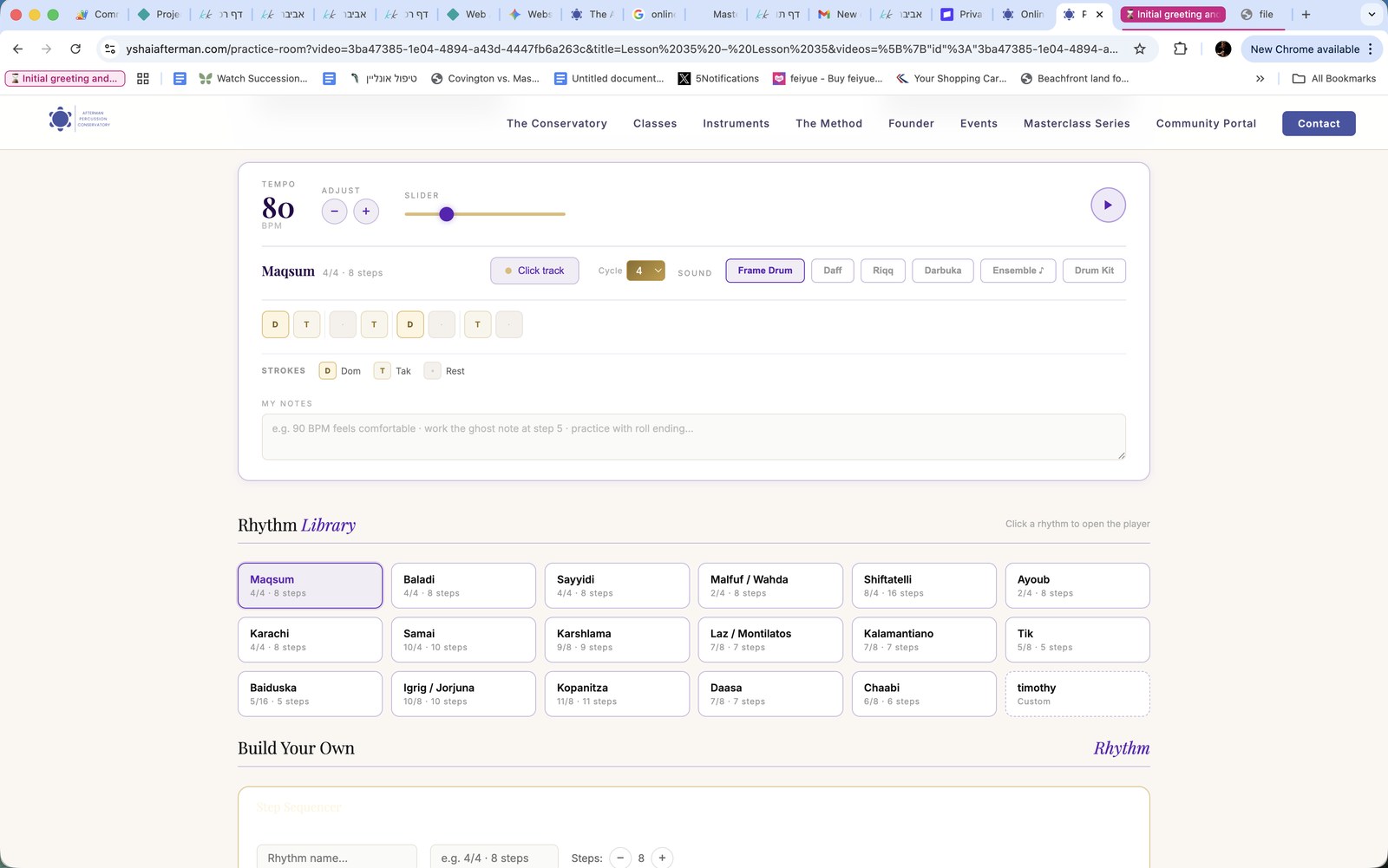
Between sessions, every darbuka student works inside the private Conservatory Portal — recorded lessons with notation PDFs, the guest-masterclass library, progress tracking, and an interactive rhythm library and metronome in the Practice Room.

The Conservatory Portal events feed with upcoming masterclasses and open mic nights

Events feed

The Conservatory Portal lesson player with video, notation, and lesson notes

Lesson library

The masterclass library with sessions from world-class guest teachers

Masterclass series

The Practice Room with rhythm library and metronome

Practice room

When I decided to deepen Middle East percussion — by far, Yshai is the best teacher I have ever had. He talks about the poetry of music and at the same time continuously crafts the tools of expression.

Giovanni Lo Cascio · Italy · Professional musician since 1981

Students

What students say

Students who arrive having studied darbuka elsewhere often describe the same thing — that they are, in a real sense, starting again. Not for lack of effort, but because the depth, structure, and personal guidance here take them somewhere they didn't know they could go.

As a beginner of darbuka and an experienced conga player, I joined the Darbuka Group last year. Yshai creates a supportive, joyful, deeply enriching learning environment. His blend of traditional technique, cultural context, and personal warmth makes every lesson an exciting journey into the heart of music.
Edgar Weitzel · Germany · Darbuka
Once in a lifetime, you may study with a master. Yshai is that master. His teaching goes far beyond technique — it transforms the way you hear, think about, and relate to music.
Tamara Kolton · USA · Lapstyle & Upright Frame Drum
I started studying with Yshai years ago, when my knowledge of darbuka, frame drum and riqq were next to zero. His methods and compositions have allowed me to find my connection with these instruments like never before.
Eugene Toh · Singapore · Darbuka, Frame Drum & Riqq
Yshai's system is extremely well structured, and he recognises exactly what each individual student needs — whether you're a beginner or advanced. It really was the best decision I made.
Sybille Camenzind · Switzerland · Lapstyle & Darbuka

Enrollment

$155 / month

Billed monthly · Cancel anytime

Enroll for September 2026 →
Reduced-rate placements. The Conservatory is committed to making serious teaching accessible to dedicated students around the world. A small number of reduced-rate placements are therefore offered each cycle to those living in countries with significantly different economic conditions, or facing exceptional personal circumstances. These are decided case-by-case. If this applies to you, write to yafterman@gmail.com with your situation before enrolling.

Questions

Darbuka lessons — common questions

Do I need my own darbuka to start?
Yes — you'll want your own goblet drum from the first lesson. A standard cast-aluminium darbuka is ideal, and we're glad to advise on choosing and tuning one before you enroll. You don't need an expensive instrument to begin.
What's the difference between a darbuka, a doumbek, and a tabla?
They're essentially the same family of goblet drum under different regional names — darbuka, doumbek, tablah, and derbake. The techniques you learn here apply across all of them.
I've played other hand drums — congas, cajón, djembe. Will this help?
Very much. Your hands and timing transfer, and the structured approach to rhythmic language gives experienced percussionists a framework many say they'd been missing. Beginners are equally welcome.
Which darbuka rhythms will I learn?
The method goes deep into traditional rhythms from across the Arabic, Turkish, Greek, Balkan, and North African traditions — and more — with a special focus on odd meters: the asymmetric cycles such as 5/8, 7/8, 9/8 and beyond. Everything is built up through basic strokes, split-hand technique, triplet rolls, and the techniques built on these, with original compositions written over them.

More about joining, schedules, and how the groups work is on the classes page.

Want to dig deeper?