Yshai Afterman · Online Course
The Complete Darbuka Course
"Crackling fire, her dance — amaranth."
Yshai Afterman · Online Course
"Crackling fire, her dance — amaranth."
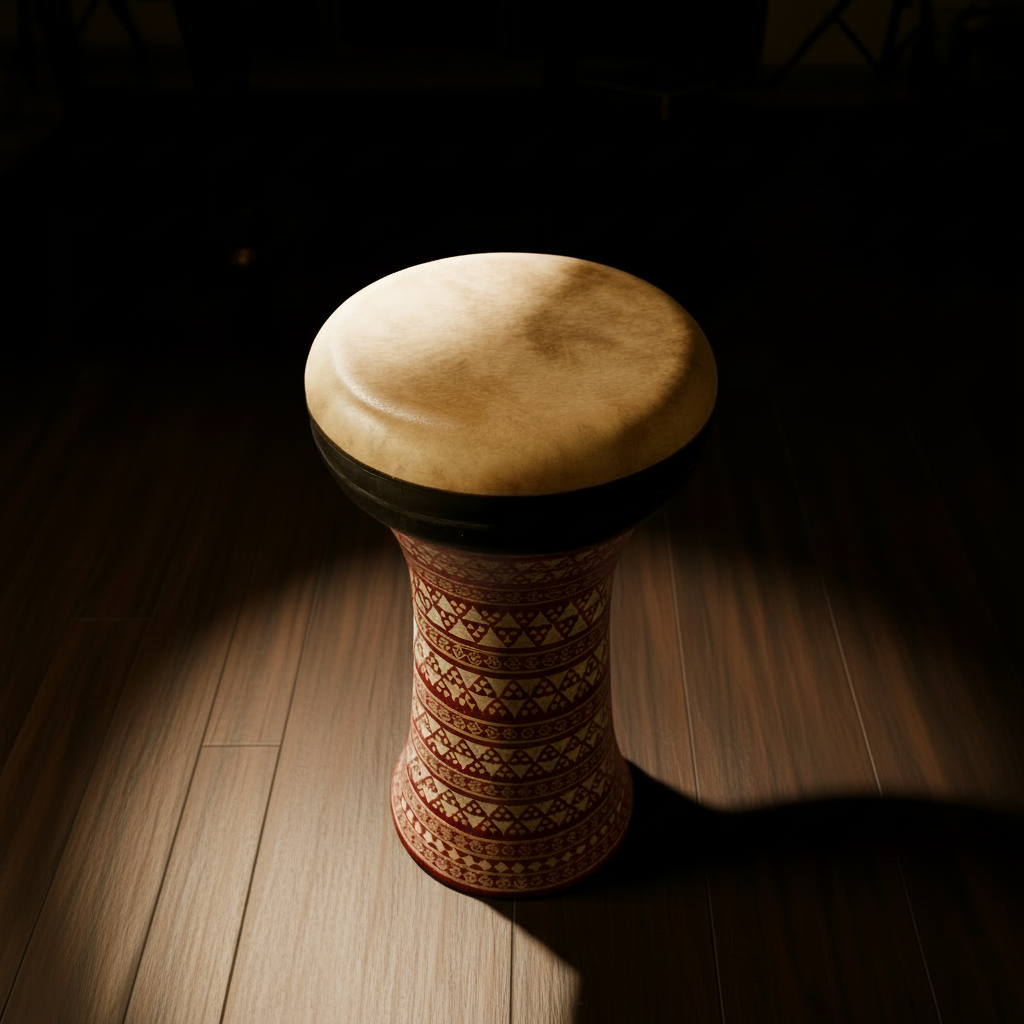
The darbuka is one of the most expressive and technically demanding drums in the Middle Eastern tradition — and one of the least taught with any real depth. What you are looking at is the most comprehensive darbuka curriculum ever built: ten levels, twenty stages, and a systematic method that develops every dimension of the instrument in parallel — stroke technique, speed, ornamentation, positional vocabulary, foot bell independence, and compositional thinking — from first grip to full mastery.
Nothing is invented on the fly. Nothing is isolated. Every technique enters the traditional repertoire from the moment it is learned. The building block system means you always know what you're playing and why — and you compose from the very first stage.
The 10-Level Journey
Everything begins here. Positioning, the first strokes, and the building block system that runs through the entire course — applied immediately to real traditional rhythms.
First traditional rhythms: maqsum and malfuf. Subdivision, phrasing, and musical context introduced alongside technique development.
Increasing speed, first ornaments, and developing endurance. The full maqsum and malfuf vocabulary begins to open up.
Split hand deepens with 16th-note number orchestration and a full pyramid phrase. Hand independence enters with left-hand malfuf across all traditional rhythms. Rhythmic orientation — starting short phrases from different beats and landing on the 1 — develops musical flexibility.
The muted Ka deepens into the numbers system and 2-group vocabulary. Hand independence extends into odd time feels and Malfuf-as-4 with 15 variations. The split hand pyramid phrase enters Laz. A new technique — The Flow — appears at the close of the level.
The muted Ka becomes a leading voice — opening phrases rather than ornament. Independence deepens with 2-bar left-hand mixing sequences and Malfuf-as-2-groups. The Flow merges with the numbers system. A brand-new technique — the double stroke roll — appears at the close of the level.
Every Tak becomes a muted Ka — the full traditional rhythm vocabulary is transformed. The double stroke roll enters the numbers system. Independence deepens with 2-bar mixed sequences. The Flow merges with orchestrated split hand variations.
Traditional rhythms are now played twice — once normal, once with muted Taks — forcing full command of ghost notes and musical flow. 12/8 independence arrives divided into 4 groups of 3 with permutations. The double stroke roll gains a complete numbers vocabulary with strong-hand accents. In Stage 2, traditional rhythms move into 16th notes with all Taks muted. Flows expand to 5-7-8 with ghosted numbers and orchestrated split hands. Karachi enters with muted Ka variations.
The course is currently in development. Get in touch to be notified when it launches, or to ask about private lessons in the meantime.
Get in touch